Worms Eat My Garbage!
It's the title of a great book on worm composting, and it gets the point across right away! Vermicomposting is using worms to eat primarily leftover food waste to make compost.
The vermi in vermicomposting is German for worm, hence "worm composting." Vermicomposting uses primarily food waste and is great for apartment dwellers, as it requires a small footprint and doesn't generate smells.
If you generate lots of yard waste in addition to food waste, you're better off choosing an aerobic composting option. You'll find details on our Home Composting Page.
What kind of worms are used?
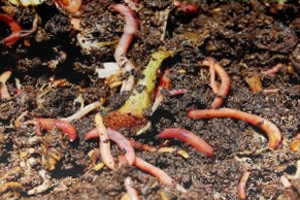
A specific type of surface feeding worm, the Red Wiggler, is used for vermicomposting. Most worms live deep in the soil and only come to the surface to eat. Red Wigglers, however, like to spend most of their time at the surface, living in the food they eat. They're very good eaters, too. Would you believe that these little guys can consume their whole body weight in just one day? They're perfect for vermicomposting!
In addition to food scraps, your worms will also eat their bedding material, most commonly newspaper. Other materials work well, too. Get the full details in our Composting ABC's booklet, available in English and Spanish. You can request a copy by calling 805-882-3600 or emailing us at LessIsMoreSB@countyofsb.org
How do I start vermicomposting?
There are many tutorials online for how to make your own vermicomposter. However, if you're looking for something easy and cost-effective, the County now sells "The Essential Living Composter" vermicomposters at-cost to County residents!
These vermicomposters are small enough to fit easily inside your home or apartment, and come in plum and black. They cost $50 -- almost half the retail price! (Please note -- worms not included! Call your local garden store to check on worm availability, or consider purchasing them online if not available locally.)

What are the specs?
Where can I get one?
The bins are available to Santa Barbara County residents only. Please note: each location has different payment instructions, please check the instructions for the location closest to you before purchasing.
South Coast Recycling and Transfer Station
4430 Calle Real, Santa Barbara
Accepts Visa or Mastercard
Santa Ynez Valley Recycling and Transfer Station
4004 Foxen Canyon Road, Los Olivos
Accepts Visa or Mastercard
North County Public Works Building*
620 West Foster Road, Orcutt
*This location only accepts exact cash or check made
out to “County of SB/RRWM”
New Cuyama Transfer Station**
5073 CA-166
New Cuyama, CA 93254
**Purchases must be made online in advance at www.LessIsMore.org/payment
Pick-Up Instructions:
- Upon arrival at the South Coast or Santa Ynez Valley transfer stations, please drive up to the scale house and wait to be rung up by the attendant; if there's a line, please continue to wait and do not walk up to the scale house.
- Call ahead if you have a specific color you need to ensure that it's in stock at that location.
- Don't forget to request a copy of the Composting ABC's!
I live in New Cuyama. Is there a way for me to purchase and pick up a discount compost bin nearby?
Yes! You can pick up a vermicomposter from the New Cuyama Transfer Station. However, purchases for discount compost bins at this location must be made in advance online at www.LessIsMore.org/payment. The only online payment method accepted is credit card. Once your online payment is processed, you may pick up your compost bin order at the New Cuyama Transfer Station during normal business hours. Please allow at least 48 hours for payment processing before picking up your order. Check out these detailed instructions in English and Spanish on how to use the payment portal to purchase a discount compost bin for pickup at the New Cuyama Transfer Station.
Please note this online payment portal is for discount compost bin orders available for pickup at the New Cuyama Transfer Station ONLY. It is not necessary to purchase discount compost bins in advance for any of our other pickup locations.
Where to go
-
Goleta & UCSB Area (2)
- *South Coast Recycling & Transfer Station — 4430 Calle Real
- Island Seed and Feed — 29 South Fairview Avenue
-
Santa Ynez Valley (1)
- *Santa Ynez Valley Recycling and Transfer Station — 4004 Foxen Canyon Road
-
Santa Maria Valley (1)
- *North County Public Works Building — 620 W Foster Road
-
Cuyama Valley (2)
- *New Cuyama Transfer Station — 5073 Highway 166
- *Ventucopa Transfer Station — Highway 33
Related Materials
- Recycling Resource Guide
- Home Composting
- Retail Compost Bins
- Discount Compost Bins
- Benefits of Composting
- Composting Workshops
- Waste Reduction Tours
- ReSource Center Experience
Related Articles
-
Christmas Tree Recycling
December 26, 2023 by Kaitlyn Haberlin - Organics -
Keep Your Waste in Check This Holiday Season
December 21, 2018 by Leslie Robinson - Reduce & Reuse -
“Less Is More” Guide Hot Off the Press
January 18, 2023 by Kaitlyn Haberlin - Recycle, Reduce & Reuse -
America Recycles Day November 15th
November 08, 2019 by Leslie Robinson - Recycle -
World Food Day October 16
October 09, 2018 by Leslie Robinson - Organics -
County Programs Available to Reduce Organic Waste
April 09, 2018 by Sam Dickinson - Organics -
RRWM’s Annual Waste Management Report Now Available
October 05, 2017 by Alan Nakashima - Recycle -
County Awarded for Excellence in Solid Waste Management
August 15, 2017 by Tom Chiarodit - Recycle -
Mini Composting Workshops this Thursday at SBCC’s Earth Day Event
April 17, 2017 by Sam Dickinson - Organics -
Taking a Further Look at Food Waste
September 05, 2014 by Leslie Robinson - Organics -
Learn the Composting ABC’s
April 15, 2014 by Sam Dickinson - Organics -
County Mulch Available for Drought Relief
February 13, 2014 by Tom Chiarodit - Organics -
Redefining Waste Recovery
June 03, 2019 by Carlyle Johnston -
Compost Your Pumpkins (and other organics)!
November 01, 2019 by Sam Dickinson - Organics -
New Food Forward Booklet!
July 30, 2023 by Kaitlyn Haberlin - Organics -
2019/2020 Resource Recovery Waste Management Annual Report Now Available!
January 11, 2021 by Tori Kampmann -
County’s ReSource Center Is Helping Many Residents Recycle their Organics
January 20, 2022 by Kaitlyn Haberlin - Organics -
Screen Your Green (bin)!
September 01, 2024 by Kaitlyn Haberlin - Organics -
Say Hello to Vermicomposters!
January 21, 2026 by Elizabeth Braun